
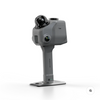
3DMakerpro Raven: finally a LiDAR scanner that doesn't cost as much as a car
, by Strato3D, 4 min reading time
, by Strato3D, 4 min reading time
The 3DMakerpro Raven is the first professional handheld LiDAR scanner under €1,400: 50m range, 4K point cloud, 1.1 kg. Ideal for architectural surveys, reverse engineering, and scan-to-print workflows.
A few years ago, if you wanted a LiDAR scanner that actually worked—I mean for environmental surveys, not for scanning small desk objects—you'd open the Faro or Leica catalog and prepare to spend at least 15,000 euros. Often much more. Then you'd add the software, training, and support. The result was that only large engineering firms, a few multinational corporations, and some well-funded universities used this stuff.
The 3DMakerpro Raven changes the game. It's not perfect—I'll say that upfront so it doesn't sound like an advertisement—but it's the first time such a tool has come at a price that an independent professional or a medium-sized laboratory can truly consider.
The Raven is a portable LiDAR scanner: you hold it in your hand (it weighs 1.1 kg, less than a 14-inch laptop), move it around the room or environment you want to survey, and it builds a colored 3D point cloud in real-time. When you're done, you have a digital model of the environment.
The range is up to 50 meters, with a stated accuracy of approximately 2 centimeters. The field of view is 360° horizontal by 40° vertical—practically no blind spots if you walk normally.
That said, the question I often get is: but what do I do with it if I'm doing 3D printing?
The answer is that the scanner doesn't replace the printer, of course, but it's the missing piece in many workflows. Do you have a mechanical component to reproduce but don't have the original CAD file? Scan it, get the mesh, send it to print. Do you have an environment to document for a client before installing something? Scan it in 20 minutes instead of manually measuring for hours. Do you work in the AEC sector and need an as-built model of a room? Same thing.
The workflow scan → model → print is what we use every day for reverse engineering components. Before having accessible tools like this, you either outsourced everything or bought something that cost three years' salary.
Technically: 150,000 points per second, 12-megapixel Sony sensor, integrated SLAM system (combines LiDAR + IMU + GPS, so it always knows where it is without the need for physical markers on the ground). There's also 4K Gaussian Splatting for photorealistic outputs, useful if you need to present the survey to a client.
The integrated 3.9'' AMOLED touchscreen display is a detail I like: you can use it independently, without having to carry around an open laptop. The battery lasts about 2 hours of continuous use, and in the meantime, you can keep it charging with an external power bank—practical if you're on a construction site all day.
On Strato3D, it's available in three variants:
| Variant | Price | When it makes sense |
|---|---|---|
| Standard | €1,368.75 | Indoor surveys, documentation, VR/game |
| Max | €2,149.00 | More extensive outdoor, long sessions |
| Max + RTK | €2,941.00 | Surveys with precise GPS geo-referencing |
There are also two accessories: the 360 Camera Kit (€71.41) for more complete panoramic acquisitions, and the Battery Grip (€142.80) if you know you'll be working in the field for a long time without stopping.
To understand its positioning: the Standard variant costs less than a good professional printer. Equivalent Faro or Leica scanners are 15-20 times more expensive. They don't replace the Raven for high-precision engineering applications—it works at 2 cm accuracy, not 0.5 mm—but for 90% of practical cases I see every week, 2 cm is perfectly fine.
The accuracy of ~2 cm automatically excludes reverse engineering of precision mechanics. If you need to reconstruct a valve seat or a gear profile, you need a structured light scanner with tolerances in the order of a tenth of a millimeter—like a Revopoint RANGE 3 or similar.
The included software (Makercloud) does its job, but if you need to deliver processed point clouds to an engineer working with Autodesk Recap Pro or Leica Cyclone, you'll probably need to export and continue processing there.
It's not a serious flaw; it's simply the boundary between the prosumer segment and the pure professional one. Knowing where that boundary lies, you can decide if the Raven is enough for you or if you need something more.
AEC professionals who perform interior surveys. Manufacturing technical offices—especially here in Milan and Lombardy—that document departments or facilities. 3D printing services that want to offer in-house 3D acquisition to their clients without outsourcing everything. Universities and museums that document heritage. Game developers and 3D artists who use environmental scans as a basis for assets.
If you fall into one of these categories and are still using a tape measure and paper notes for surveys, the Raven is definitely worth a look.
👉 View the 3DMakerpro Raven on Strato3D — Standard €1,368.75 · Max €2,149.00 · Max + RTK €2,941.00. Shipped from an Italian warehouse.
👉 Do you have questions about which variant is right for you, or want to understand if it integrates into your workflow? Contact us — we are in Milan and Perugia.


